
Quick Guides
Are Brass Knuckles Legal? State-by-State Guide 2026
Aug
Every year, thousands of Americans search for clarity on a critical question: are brass knuckles legal in their state? At Knuckles Warriors, we’ve spent years helping customers navigate the complex—and often confusing—landscape of self-defense tool regulations. Whether you’re an EDC enthusiast, a collector, or someone looking for reliable personal protection, understanding the law is the first step to staying safe and compliant.
This 2026 guide breaks down federal and state laws, highlights key legal concepts, and provides a state-by-state reference table. We’ll also share practical tips to ensure you’re always on the right side of the law.
Quick Answer: Are Brass Knuckles Legal?
For those asking, “are knuckles legal?”—the short answer is: it depends on where you live. In the United States, there is no federal law that explicitly bans brass knuckles for civilians. However, individual states have the authority to regulate, restrict, or outright prohibit their possession, sale, and carry. Some states treat them as legal tools, while others classify them as prohibited weapons.
At Knuckles Warriors, we always advise our customers to check your local and state laws before purchasing or carrying any self-defense tool. Ignorance of the law is not a valid defense, and penalties can range from misdemeanors to felonies.
The Legal Landscape in 2026
As of 2026, the legal status of brass knuckles remains a patchwork across the U.S. Some states have recently updated their laws—for example, Texas legalized brass knuckles in 2019, while other states like New Hampshire have considered but not yet passed similar reforms. The trend in some regions is toward greater acceptance for self-defense, but in others, restrictions remain tight.
Federal Laws on Brass Knuckles
Many people ask, “are brass knuckles legal under federal law?” The answer is yes—at the federal level, there is no specific statute banning brass knuckles for civilian possession. However, there are relevant federal laws to consider:
The National Firearms Act (NFA) and Weapons Regulations
The NFA regulates certain weapons like machine guns and short-barreled rifles, but brass knuckles are not classified under this act. Federal law primarily defers to state and local jurisdictions for regulation of knives, impact weapons, and similar tools.
Interstate Commerce and Transport
If you’re traveling across state lines, federal law does not protect you from state-level bans. Carrying brass knuckles into a state where they are illegal can result in criminal charges, even if you purchased them legally in another state. This is why we emphasize knowing the laws of your destination—not just your home state.
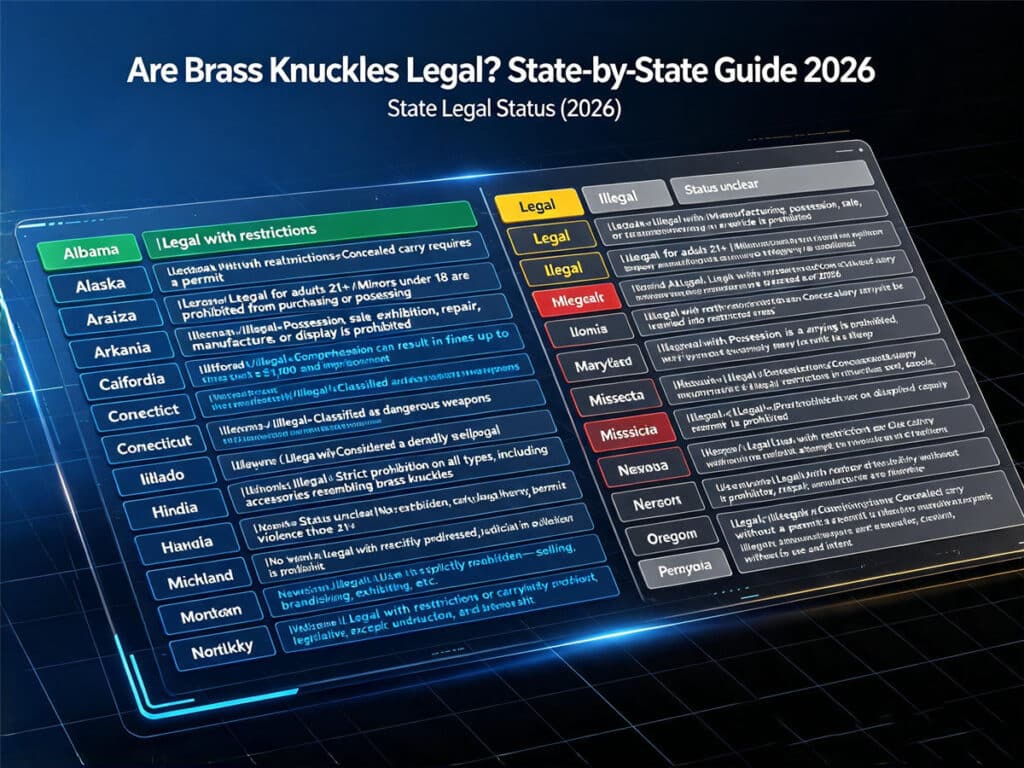
State-by-State Legal Status (2026)
If you’re wondering, “are brass knuckles legal in my state?” the table below provides a comprehensive overview. Below is a comprehensive table summarizing the legal status of brass knuckles in each U.S. state as of 2026. This table is for informational purposes only and should not be considered legal advice. Laws change frequently, so always verify with local authorities or an attorney.
| State | Legal Status (2026) | Key Notes |
|---|---|---|
| Alabama | Legal with restrictions | Concealed carry requires a permit. |
| Alaska | Illegal | Manufacturing, possession, sale, or transport is prohibited. |
| Arizona | Legal for adults 21+ | Minors (under 18) are prohibited from purchasing or possessing. |
| Arkansas | Illegal | Possession, sale, exhibition, repair, manufacture, or display is prohibited. |
| California | Illegal | Comprehensive ban on all forms—metallic or synthetic. |
| Colorado | Illegal | Possession can result in fines up to $1,000 and imprisonment. |
| Connecticut | Illegal | Classified as “dangerous weapons.” |
| Delaware | Illegal | Considered a deadly weapon. |
| Florida | Legal with restrictions | Concealed carry requires a permit; sale or delivery is prohibited. |
| Georgia | Legal with restrictions | Considered a “prohibited weapon”—possession may lead to charges. |
| Hawaii | Legal with restrictions | Sale and possession allowed, but transporting in a vehicle is prohibited. |
| Idaho | Status unclear | Not explicitly addressed; courts evaluate based on intent and use. |
| Illinois | Illegal | Strict prohibition on all types, including accessories resembling brass knuckles. |
| Indiana | Legal | No specific prohibition; using them in violence is illegal. |
| Iowa | Status unclear | Not explicitly addressed; judicial evaluation required. |
| Kansas | Illegal | Explicitly forbidden—selling, brandishing, exhibiting, etc. |
| Kentucky | Legal | Concealed carry allowed without a permit for those 21+. |
| Louisiana | Legal with restrictions | Concealed carry requires a valid permit. |
| Maine | Illegal | Possession is a Class D crime; use in assault can be a felony. |
| Maryland | Legal with restrictions | Concealed carry without a permit is illegal. |
| Massachusetts | Illegal | Possession, sale, and manufacture are prohibited. |
| Michigan | Illegal | Strict prohibition on all types, including jewelry and accessories. |
| Minnesota | Illegal | Prohibited—sale, display, repair, production, and ownership. |
| Mississippi | Legal with restrictions | Concealed carry without a permit is prohibited. |
| Missouri | Legal | Legal to possess, but cannot be carried into restricted areas (schools, government buildings). |
| Montana | Status unclear | Not explicitly defined; courts evaluate based on use and intent. |
| Nebraska | Legal with restrictions | Concealed carry without a permit is illegal; restrictions in churches, schools, bars. |
| Nevada | Illegal | Possession, sale, exhibition, or manufacturing is prohibited. |
| New Hampshire | Illegal | Selling or carrying is prohibited (note: legislative attempts to legalize have not passed as of 2026). |
| New Jersey | Illegal | Possession and carrying are illegal, with limited exceptions (theatrical, collections). |
| New Mexico | Legal with restrictions | Concealed carry without a permit is prohibited. |
| New York | Illegal | Use is strictly prohibited (metallic or synthetic). |
| North Carolina | Legal with restrictions | Concealed carry without a permit is illegal. |
| North Dakota | Legal with restrictions | Concealed carry without a permit is prohibited. |
| Ohio | Status unclear | Not explicitly addressed; could be classified as deadly weapons. |
| Oklahoma | Illegal | Carrying offensive weapons is prohibited, except under the Self-Defense Act. |
| Oregon | Legal with restrictions | Concealed carry without a permit is illegal. |
| Pennsylvania | Illegal | Use and possession are prohibited—metal or plastic. |
| Rhode Island | Illegal | Possession and carrying are prohibited. |
| South Carolina | Legal | No concealed carry permit required; prohibited in schools and medical facilities. |
| South Dakota | Legal | Permissible to possess; carrying with intent to harm is illegal. |
| Tennessee | Illegal | Possession or use is strictly forbidden. |
| Texas | Legal | Fully legalized in 2019 for self-defense purposes. |
| Utah | Status unclear | Not explicitly addressed; judicial evaluation required. |
| Vermont | Illegal | Possession, use, or sale is prohibited. |
| Virginia | Illegal without permit | Concealed carry without a permit is illegal; repeat offenses escalate to felonies. |
| Washington | Illegal | Possession, distribution, or production is a gross misdemeanor. |
| West Virginia | Illegal without permit | Concealed carry without a permit is illegal. |
| Wisconsin | Legal with restrictions | Legal at home, but concealed carry without a permit is illegal. |
| Wyoming | Legal with restrictions | Possession is legal, but concealed carry is prohibited. |
Disclaimer: This table is a simplified overview. Some states have additional local ordinances, age restrictions, or specific use-case exceptions (e.g., theatrical props, collections). Always consult official state statutes or a legal professional.
Key Legal Concepts You Must Know
Understanding the law isn’t just about knowing whether brass knuckles are legal—it’s about grasping the nuances that can affect your rights and responsibilities.
Concealed vs. Open Carry
If you’re wondering, “are knuckles legal to carry openly?” the answer varies by state. Many states distinguish between concealed carry (hidden on your person) and open carry (visible). Even in states where brass knuckles are legal to own, carrying them concealed often requires a permit. For example, in states like Alabama, Florida, and Nebraska, you can possess brass knuckles at home, but carrying them hidden without a permit is a misdemeanor.
Intent and Use
Understanding brass knuckles legality2026 requires looking beyond the letter of the law to how courts interpret intent. In states where the law is ambiguous (e.g., Idaho, Iowa, Montana, Ohio, Utah), courts often evaluate cases based on intent. If you’re carrying brass knuckles for self-defense and can demonstrate lawful purpose, you may have a stronger defense. However, using them in an assault—even in self-defense—can escalate charges significantly.
Material Matters
Some laws specify “metallic knuckles,” but others include synthetic, plastic, or composite materials. In states like California and Illinois, the ban applies to all materials. Don’t assume that non-metal brass knuckles (like carbon fiber or polymer) are legal if your state bans “brass knuckles” generally. Knuckle dusters legal status often hinges on material composition, so always check the specific wording of your state’s statute.
How to Stay Compliant
At Knuckles Warriors, we believe in responsible ownership. Whether you’re researching brass knuckles laws by state or already own a pair, here’s how to make sure you’re always on the right side of the law:
1. Research Before You Buy
Before purchasing brass knuckles, verify your state and local laws. Use official state legislature websites or consult a lawyer. Don’t rely solely on online articles—laws change, and local ordinances may add restrictions.
2. Understand Carry Restrictions
If your state allows possession but restricts concealed carry, consider open carry where legal or invest in a concealed carry permit if available. Remember, even with a permit, some locations (schools, government buildings, bars) may still be off-limits.
3. Transport Safely
When traveling, keep brass knuckles unloaded and stored separately from your person, ideally in a locked container in your trunk. This is especially important when crossing state lines.
4. Use Common Sense
Even where legal, avoid using brass knuckles in a threatening or aggressive manner. The legal system often considers context—carrying for self-defense is different from brandishing in a dispute. At Knuckles Warriors, we design our brass knuckles collection for responsible users who prioritize safety and legality.
Frequently Asked Questions
Q: Are knuckles legal for self-defense?
A: It depends on your state. In states where brass knuckles are legal, they can be used for self-defense. However, using them in an assault—even in self-defense—can lead to serious legal consequences. Always understand your state’s self-defense laws.
Q: Are plastic or polymer brass knuckles legal?
A: In many states, yes—if the law specifies “metallic” knuckles. However, in states like California, Illinois, and New York, the ban includes all materials. Always check your state’s specific wording.
Q: Can I carry brass knuckles on an airplane?
A: No. The TSA prohibits brass knuckles in both carry-on and checked luggage. They are considered prohibited items under federal aviation regulations.
Q: Do city or county laws override state laws?
A: Yes, in many cases. Local ordinances can be stricter than state laws. For example, a state may allow possession, but a city within that state may ban it. Always check both state and local regulations.
Q: What happens if I’m caught with brass knuckles in an illegal state?
A: Penalties vary by state but can include fines, confiscation, misdemeanor charges, or even felony charges if used in a crime. In some states, possession alone can lead to jail time.
Q: Are brass knuckles considered “deadly weapons”?
A: In some states, yes. This classification can escalate charges, especially if used in an assault. In ambiguous states, courts decide based on intent and use.
Q: Can I sell brass knuckles online?
A: It depends on your state and the buyer’s state. You must comply with both your state’s laws and the buyer’s state laws. Many online retailers restrict sales to states where brass knuckles are legal.
Disclaimer: This article is for informational purposes only and does not constitute legal advice. Laws regarding brass knuckles vary by jurisdiction and are subject to change. Always consult with a qualified attorney or local law enforcement for specific legal guidance.
At Knuckles Warriors, we’re committed to providing high-quality, legal self-defense tools while promoting responsible ownership. Whether you’re looking for brass knuckles, tactical pens, or self-defense keychains, we’ve got you covered. Explore our full collection and carry with confidence—knowing you’re informed, prepared, and protected.