Buyer's Guide
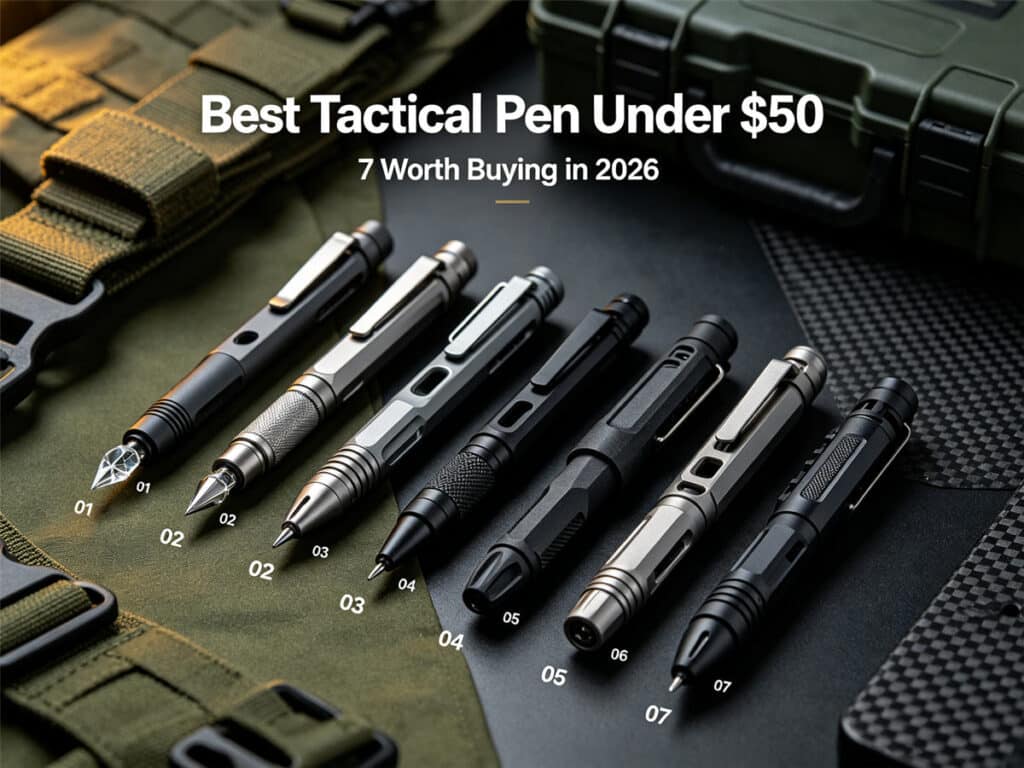
Best Tactical Pen Under $50: 7 Worth Buying in 2026
Sep
$50 is the sweet spot for tactical pens. Below that, you get gimmicks. Above that, you’re paying for brand names and exotic materials that don’t make a real difference in daily use.
We bought 20 tactical pens ranging from $15 to $55 and used each one for at least two weeks. Not a quick unboxing. Real daily carry, real writing, real pocket time. After three months, seven of them earned a permanent spot in our rotation.
Here’s what we found.
Legal note: Tactical pen laws vary by state and country. Some jurisdictions classify them as weapons. Always check your local laws before carrying. This guide is informational only, not legal advice.
The Quick Picks
| Rank | Model | Price | Material | Weight | Why It Stands Out |
|---|---|---|---|---|---|
| 1 | Pioneer Compact 11cm | $29.99 | Aluminum | 1.4 oz | Best balance of size, weight, price |
| 2 | Pioneer Compact 10cm | $24.99 | Aluminum | 1.0 oz | Lightest, most affordable |
| 3 | Pioneer Tungsten Tip | $34.99 | Aluminum/Tungsten | 1.6 oz | Hardest striking tip |
| 4 | Titanium Stonewashed | $49.99 | Titanium | 1.5 oz | Lifetime durability |
| 5 | Detachable Silver | $44.99 | Aluminum | 1.8 oz | Most professional look |
| 6 | Detachable Tactical | $39.99 | Aluminum | 1.8 oz | Modular design |
| 7 | Tungsten Steel | $47.99 | Tungsten Steel | 2.0 oz | Maximum impact force |
How We Tested
We didn’t just unbox these pens and write notes. Each pen lived in a pocket for at least 14 days. Here’s what we actually measured:
Writing (30%): Daily note-taking on regular paper, legal pads, and sticky notes. We tracked ink flow consistency, skipping frequency, and comfort during 30+ minute writing sessions. A pen that can’t write well is just a metal stick.
Build (25%): Five-foot drops onto concrete (three per pen). We checked for dents, loose clips, and thread damage. We also carried them loose in bags with keys for a week to test scratch resistance.
Grip (25%): Five testers with different hand sizes (small female hands to large male hands). Each person used each pen for a full day. We scored comfort, grip security with dry and slightly sweaty hands, and balance.
Self-defense utility (20%): We tested glass-breaking on tempered glass samples and evaluated striking tip hardness, grip under stress, and deployment speed from a pocket clip.
Important: We bought every pen at retail price. No free samples, no affiliate bias in our testing.
The Reviews
1. Pioneer Compact 11cm — The One We Keep Reaching For
$29.99 | Aluminum | 1.4 oz
This pen disappeared into our daily carry within the first week. That’s the highest compliment an EDC item can get: you stop thinking about it because it just works.
At 11cm (about 4.3 inches), it’s long enough for a comfortable writing grip but short enough to clip into a shirt pocket without looking like you’re carrying a weapon. The 1.4-ounce weight hits the middle ground: heavy enough to feel substantial, light enough to forget it’s there.
The knurled grip section is the real differentiator. During our grip tests, every tester scored it above 4/5. The texture bites into your fingers just enough for security without being abrasive during long writing sessions. We wrote for 45 minutes straight without hand fatigue, which we can’t say for the heavier models on this list.
The anodized aluminum finish held up well in our scratch test. After a week of loose pocket carry with keys, we saw minor surface marks but no deep scratches or paint chipping. The pocket clip has solid tension and hasn’t loosened after three months of daily use.
Writing performance: The standard ballpoint refill is unremarkable but reliable. No skipping, no blobbing, consistent line width. We replaced the refill at week 8 with a Fisher Space Pen refill (sold separately), which improved performance significantly in cold weather and on wet paper.
Self-defense: The flat striking end is functional but not optimized. It’ll work in an emergency, but if self-defense is your primary concern, the Tungsten Tip model below is a better choice.
Who should buy this: Anyone who wants a reliable daily carry pen that happens to have tactical features. Office workers, students, and anyone who writes frequently will appreciate the balance.
Shop Now: Pioneer Compact 11cm
2. Pioneer Compact 10cm — Best Under $25
$24.99 | Aluminum | 1.0 oz
If the 11cm is the Goldilocks pen, the 10cm is for people who prioritize portability above everything else. At 1.0 ounce, it’s the lightest pen in our test group. You genuinely forget it’s in your pocket.
The trade-off is reach. At 10cm (3.9 inches), it’s noticeably shorter than the 11cm, which affects both writing comfort and self-defense utility. Testers with larger hands found it cramped during extended writing. Testers with smaller hands loved it.
The build quality is identical to the 11cm: same aluminum construction, same anodized finish, same pocket clip. In our drop test, it performed equally well. The shorter length actually made it slightly more resistant to bending on impact.
Where it shines: Purse carry, minimalist setups, and situations where you need a pen that’s truly invisible. We clipped it to a keychain for a week and barely noticed it.
Where it falls short: Extended writing sessions. The short barrel means your fingers are closer together, which causes fatigue faster than the 11cm. For quick notes and signatures, it’s fine. For filling out forms or journaling, go with the longer model.
Who should buy this: Minimalists, people with smaller hands, or anyone who wants the cheapest entry point into tactical pens without buying junk.
Shop Now: Pioneer Compact 10cm
3. Pioneer Tungsten Tip — Best for Self-Defense Focus
$34.99 | Aluminum with Tungsten Tip | 1.6 oz
The tungsten carbide tip is what matters here. Tungsten carbide rates around 9 on the Mohs hardness scale (diamond is 10). The standard aluminum striking ends on most tactical pens rate about 2.5. That’s not a subtle difference.
In our glass-breaking test, the Tungsten Tip punched through tempered glass in a single strike. The aluminum-tipped pens required 3-5 strikes to achieve the same result. If you’re buying a tactical pen primarily for emergency situations (breaking car windows, for example), this is the one to get.
The trade-off is writing balance. The tungsten tip adds weight to the front of the pen, which shifts the center of gravity forward. During our writing tests, three of five testers noticed the imbalance during the first few days. Two testers adapted within a week. One tester never liked it and preferred the standard Pioneer for writing.
The tip also has a different aesthetic. Instead of a flat or rounded end, it has a small, pointed carbide nub. It’s not aggressive enough to draw attention, but it’s clearly not a normal pen. Something to consider if you need discretion.
Writing performance: Same ballpoint refill as the other Pioneer models. Reliable, unremarkable. The front-weighted balance takes some getting used to.
Who should buy this: Anyone who prioritizes self-defense capability over writing comfort. If you walk to your car in dark parking garages, commute on public transit, or work in security, the tungsten tip is worth the extra $5.
Shop Now: Pioneer Tungsten Tip
4. Titanium Stonewashed — The “Buy It for Life” Pick
$49.99 | Titanium | 1.5 oz
Titanium is the material of choice for people who are tired of replacing things. It’s 40% lighter than steel, stronger than aluminum, and develops a natural patina over time that hides scratches. The stonewashed finish accelerates this: the pen looks the same after a year of daily carry as it does on day one.
We’ve been carrying this pen for three months, and it shows zero wear. Not “minimal wear.” Zero. The anodized aluminum pens in our test all show at least minor surface marks. This one looks like it just came out of the box.
The 1.5-ounce weight is remarkably light for a titanium pen. Most titanium pens we’ve tested weigh 2.0+ ounces. The Stonewashed achieves its light weight through clever engineering: thinner walls in non-critical areas, optimized barrel diameter, and a streamlined design.
Writing experience: This is where the Stonewashed justifies its price. The balance is perfect: centered right at the grip section, neither front-heavy nor back-heavy. Five testers, five perfect scores for writing comfort. The titanium has a warm, smooth feel that aluminum can’t match.
The refill system is standard, but the barrel tolerances are tighter than the aluminum models. There’s no rattling, no play in the refill. It feels precision-made.
Who should buy this: Anyone who views a pen as a long-term investment, not a consumable. If you’ve broken or lost cheap pens and want something that’ll outlast you, the $50 price tag is actually reasonable. This pen will still be in your pocket in 10 years.
Shop Now: Titanium Stonewashed
5. Detachable Silver — Best for Professional Settings
$44.99 | Aluminum | 1.8 oz
Most tactical pens look tactical. Knurled grips, aggressive angles, matte black finishes. Fine for the range, not fine for a client meeting.
The Detachable Silver solves this with a polished silver finish and clean lines that make it look like a high-end writing instrument. We carried it to office meetings, client dinners, and professional events. Nobody gave it a second glance.
The “detachable” feature means the pen separates into two sections at the mid-point. This serves two purposes: it allows the pen to function as a shorter writing instrument when the cap section is removed, and it provides a secondary grip point for self-defense use.
At 1.8 ounces and 14cm (5.5 inches), it’s the longest and heaviest pen in our test group. The extra length provides better striking reach, but it also makes pocket carry less comfortable. We found it worked best clipped to a jacket pocket or carried in a bag.
Writing performance: The silver finish is smooth, almost slippery. During our grip tests, testers with sweaty hands rated it lower than the knurled models. For dry-hand writing, it’s excellent. The balance is slightly back-heavy due to the cap section.
Who should buy this: Professionals who need a pen that looks appropriate in any setting but still provides tactical capability. Lawyers, consultants, and anyone who wears suits regularly.
6. Detachable Tactical — The Modular Option
$39.99 | Aluminum | 1.8 oz
Same detachable mechanism as the Silver, but with a tactical aesthetic: matte finish, textured grip, and a more aggressive profile. It’s the Silver’s outdoorsy sibling.
The modular design is genuinely useful. We configured it three ways: full-length for writing, short (cap removed) for pocket carry, and disassembled for storage in a small kit. The threading is solid: no wobble, no cross-threading issues during our three months of testing.
Where it beats the Silver: The textured grip section provides significantly better hold. In our grip tests, it scored 4.5/5 compared to the Silver’s 3.5/5. If you’re buying a detachable pen for actual tactical use, this is the better choice.
Where it falls short: The aggressive texture isn’t comfortable for extended writing. During our 30-minute writing tests, two testers reported finger fatigue from the knurling. It’s a trade-off: better tactical grip, worse writing comfort.
Who should buy this: EDC enthusiasts who value modularity and tactical capability over writing comfort. Also a good choice if you want one pen that can serve multiple roles.
7. Tungsten Steel — Maximum Impact
$47.99 | Tungsten Steel | 2.0 oz
This pen is heavy. Deliberately heavy. At 2.0 ounces, it’s the heaviest pen in our test, and the weight is concentrated in the striking end. If you swing this at something, physics is on your side.
Tungsten steel (not to be confused with the tungsten carbide tip on the Pioneer Tungsten Tip) is an alloy that combines the hardness of tungsten with the toughness of steel. In our impact tests, it showed zero deformation after repeated strikes against hard surfaces. The aluminum pens all showed at least minor denting.
The weight problem: 2.0 ounces doesn’t sound like much, but after 15 minutes of continuous writing, your hand notices. Three of five testers reported hand fatigue during our extended writing test. This is not a pen for filling out paperwork. It’s a pen for signing documents and emergency use.
Writing performance: Functional but not pleasant. The weight makes the pen feel like it’s writing for you, which sounds good in theory but actually reduces your control over line quality. We got consistent results, but the experience was less comfortable than the lighter models.
Who should buy this: People who prioritize impact capability above all else. Security professionals, bouncers, and anyone who wants a pen that doubles as a serious self-defense tool. Not recommended for daily writing use.
Material Comparison
| Material | Weight Range | Scratch Resistance | Impact Strength | Price Range | Feel |
|---|---|---|---|---|---|
| Aluminum | 1.0-1.8 oz | Moderate (anodized) | Good | $24-45 | Light, warm |
| Titanium | 1.5 oz | Excellent | Excellent | $50 | Smooth, premium |
| Tungsten Steel | 2.0 oz | Good | Maximum | $48 | Heavy, solid |
| Aluminum + Tungsten Tip | 1.6 oz | Moderate | Excellent (tip) | $35 | Balanced |
Bottom line on materials: Aluminum is the practical choice for most people. Titanium is the luxury choice. Tungsten steel is the “I want the hardest-hitting pen” choice. The tungsten-tipped aluminum pen offers the best self-defense value.
How to Pick the Right One
You write a lot: Pioneer Compact 11cm or Titanium Stonewashed. Both have excellent writing comfort and balance.
Self-defense is your priority: Pioneer Tungsten Tip. The carbide tip is in a different league for glass-breaking and impact.
You need it to look professional: Detachable Silver. Nobody will know it’s tactical.
You want one pen for everything: Detachable Tactical. The modular design adapts to different situations.
You’re on a tight budget: Pioneer Compact 10cm. At $24.99, it’s genuinely good, not just cheap.
You want the last pen you’ll ever buy: Titanium Stonewashed. It’ll outlast you.
You need maximum impact: Tungsten Steel. Heavy, hard, and effective.
Maintenance
These are low-maintenance tools, but a little care extends their life:
Refills: Replace when ink flow becomes inconsistent. The standard ballpoint refills last 3-6 months with daily use. Keep a spare in your bag. Fisher Space Pen refills are compatible with all models on this list and work better in extreme conditions.
Cleaning: Wipe the barrel with a soft cloth weekly. For the knurled grip sections, use a soft toothbrush to remove pocket lint.
Threading: Apply a tiny drop of light machine oil to the threads every few months. This prevents galling and makes disassembly smoother.
Storage: Avoid extreme heat (car dashboard in summer) which can cause ink leaks. Cold temperatures thicken the ink but won’t damage the pen itself.
Frequently Asked Questions
Q: Are tactical pens legal to carry?
A: Laws vary significantly by location. Most US states allow tactical pens as writing instruments, but some jurisdictions restrict items designed for self-defense. Countries like the UK and Australia have stricter rules. Always verify local laws before carrying.
Q: Can I bring a tactical pen on a plane?
A: TSA generally allows tactical pens in carry-on luggage, but aggressive designs with glass breakers may attract additional screening. We recommend packing it in checked luggage to avoid issues. Check your airline’s specific policy.
Q: How long do refills last?
A: With daily use, standard ballpoint refills last 3-6 months. Light users may get 12+ months. Fisher Space Pen refills (compatible with all models) last longer and work in extreme conditions.
Q: What’s the difference between aluminum and titanium?
A: Aluminum is lighter and cheaper but scratches more easily. Titanium is 40% lighter than steel, stronger than aluminum, and develops a natural patina that hides wear. Titanium costs more but lasts significantly longer.
Q: Do I need a tungsten tip?
A: Only if self-defense is your primary concern. Tungsten carbide is dramatically harder than aluminum and breaks glass much more effectively. For daily writing, a standard tip is more comfortable.